

Just How Many Brain Injuries Associated with One Roller Coaster Is an Acceptable Number?
Surely, it cannot be worthwhile for a theme park to keep operating a roller coaster with such a long history of brain injury allegations.
Photo via Unplash, blueberry Maki Splinter Roller Coasters
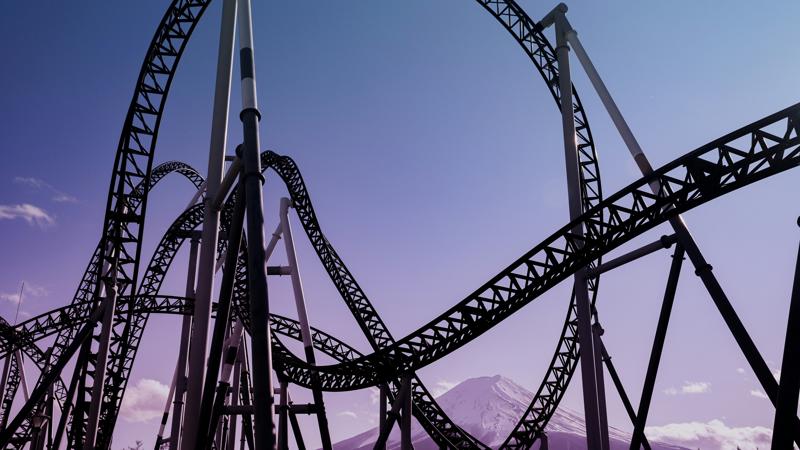
Just a handful of weeks ago, in July of this year, a 40-year-old Hawaii resident named Pamela Guillen stepped aboard the “fourth dimensional” roller coaster known as X2 at Six Flags Magic Mountain in Valencia, Calif. She was on a family vacation celebrating her daughter’s 16th birthday, and followed daughter Camille Marquez onto the coaster despite being nervous about engaging in one of the park’s most famous thrill rides. As the two-minute ride unfolded, Guillen’s family and medical records say her head was repeatedly slammed into the headrest and restraints, leaving her vomiting and disoriented as the family exited. Sitting down on a bench, she lost consciousness as the panicked family called for an ambulance. She would spend the next two weeks in a coma following brain surgery after scans revealed “a severe subdural hematoma and brain compression,” according to an in-depth investigation from CNN related to the roller coaster. She’s currently teaching herself to walk and talk again.
The ride? Oh, it apparently stayed open immediately in the wake of Guillen’s traumatic brain injury. That is, until a mere six days later, when a 25-year-old L.A. resident named Naomi Greer-Wilkinson boarded X2 alongside two siblings. Like Guillen, Greer-Wilkinson lost consciousness shortly after exiting the roller coaster, complaining of head pains. Like Guillen, she was also rushed to the hospital for emergency brain surgery. Unlike Guillen, she has not yet woken up, remaining in critical condition in a coma, hooked up to a ventilator and feeding tube. Six Flags Magic Mountain subsequently closed the ride on July 12 without offering any rationale or statement for why it was now closed. They did, however, reportedly offer the family of Greer-Wilkinson some McDonald’s when the family arrived at the hospital. They say they haven’t heard from Six Flags representatives since.
“Naomi should have never ever in a million years even had the option to get on that ride,” said mother Artemis Greer to CNN. “This is the hardest thing a human being could go through. This is cruel.”
A CNN investigation has uncovered years of reported brain injuries linked to a world-famous roller coaster. https://cnn.it/4cd8heY
— CNN (@cnn.com) 6:08 AM · Aug 27, 2026
These two women are the latest to allege, or have their families allege, that they suffered brain injuries related specifically to riding the X2 roller coaster at Magic Mountain, but they’re by no means the first. Beyond two literal cases of death that have previously been linked to the coaster, one of which resulted in a trial that was scheduled for Sept. but reportedly settled this week, CNN uncovered dozens of other reports of serious injuries and hospitalizations linked to the ride, pulling from hospital records and legal filings. From the moment it opened, the coaster has seemingly been a constant source of drama, both for the park and the many, many people who have ridden it. That said, it has also been one of the park’s top attractions for a long time, with the Six Flags brand saying the following on YouTube in 2014: “X2 has been one of the most popular thrill rides on the planet. On ordinary roller coasters, the train stays in line with the track…but there is nothing ordinary about X2.”
One would probably naturally assume that X2 must be a recent ride, for it to potentially have an opportunity to get caught up in these headlines: Some kind of brand new, state-of-the-art design that is pushing the limits of what is possible in the world of thrill rides, etc. But that’s not the case at all. Rather, X2 first opened in January 2002, constructed by longtime steel coaster experts Arrow Dynamics, who were prolific innovators in roller coaster technology from the 1970s-2000s. It was, however, the first of its kind as a “fourth-dimension roller coaster” that allows cars to unpredictably swing and rotate 360 degrees around the track itself, and there are only two other truly similar coasters of this kind and size in the world, in China and Japan. Despite its age, X2 remains a unique oddity, one that has generated a long history of complaints and allegations, but seemingly has never stayed closed for long. The company that designed it, meanwhile, went out of business the same year that X2 opened, in part because the unexpected costs of the new style of roller coaster drove it to bankruptcy.
The two instances of death linked to the ride have now both resulted in litigation that led to settlements. The first was in 2010, when a 28-year-old single mother named Hilda Farias died due to “a brain abnormality that ruptured because of the intensity of the ride,” in the opinion of medical professionals at the time. The second, reportedly just settled this week, was the case of 22-year-old Christopher Hawley, who went on the roller coaster with his cousin and brother, left complaining of head pain and lightheadedness and then collapsed. He died roughly 10 hours later following severe brain bleeding, with the neurosurgeon who operated on him comparing the injuries to a person who had suffered “shaken baby syndrome.” The medical examiner, meanwhile, ruled that the death was the result of blunt head trauma from “a park ride accident.” After almost four years, a trial had been set to being Sept. 8, 2026, before this week’s settlement with Hawley’s family.
Christopher Hawley, 22, died after sustaining severe head injuries from the X2 roller coaster at Magic Mountain, a lawsuit said. The family is looking for answers and is suing for negligence, they said.
— Los Angeles Times (@latimes.com) 8:07 PM · Mar 19, 2025
It is ultimately unknown just how many complaints or reports of injuries the park has fielded related to X2 over the years, but despite the occasional shutdown, the roller coaster has always returned to operation. CNN found that the park’s internal records “showed it had fielded at least 70 prior head and neck injury complaints from X2 riders in the three years leading up to Hawley’s death,” but the park simultaneously argued in court that its first aid and medical incident reports must be kept under seal because disclosing them would taint the jury pool in a potential trial. It seems pretty clear, meanwhile, that the park is not the least bit interested in actually allowing one of said trials to happen, given the negative PR that would no doubt result. There are certainly other cases out there where lawsuits are still slowly moving along, like that of 50-year-old Sheila Katerelos, who is suing the company that makes the X2 coaster’s trains after being diagnosed with “traumatic brain injury and multiple subdural hematomas” immediately after riding it in 2020.
It all begs the question, of course: How can it possibly be worthwhile to the theme park to continue operating a ride that has been such a figurative and literal–seemingly sometimes deadly–headache for so many? Yes, X2 clearly meets state standards and regulations for amusement park rides, and has passed inspections, or else it wouldn’t be allowed to continue operating. But surely someone at Six Flags can apply a little bit of common sense or pattern recognition here. It’s difficult to imagine how this kind of litigation, and these kinds of presumably hefty settlements, are seen as an acceptable trade-off for the ability to continue operating a roller coaster. Might we suggest that one could build a new ride on that location? One that doesn’t end up being cited in medical journals, with doctors theorizing that “advances of roller-coaster technology and industry competition for thrill-seeking patrons may ultimately improve acceleration and performance beyond the passenger’s physical ability to tolerate them”?
Even among roller coaster enthusiasts and theme park fans unaware of the actual injuries alleged to be connected to X2, or the court cases that followed, the ride has built a rather sinister reputation. Speaking as a former roller coaster junkie myself, you know that a ride has a reputation when you can find an entire reddit thread where people are debating if it’s the roughest ride they’ve ever had and sharing advice with each other on where to sit/how to position yourself to endure it without injury. As one person put it in that 2018 reddit thread: “It honestly felt like a boxer punched me in the head twice.” And as another offered by way of advice: “Holding your head back against the rest makes it even worse so do not attempt this. Instead, as the ride nears the last two maneuvers lean forward as far as you can to try to avoid or mitigate the impact. You will get some mild whiplash, but it is better.”
Yeah, you know what, I think I’m good. I don’t think I need even “mild” whiplash today. And it sounds like a bunch of other riders may share that sentiment.
 Keep scrolling for more great stories.