

The Nancy Grace Roman Telescope Is About to Change Astronomy
Named for NASA's first female executive and first Chief of Astronomy, it will provide a field of view 100 times that of Hubble.
Photo courtesy of NASA Science NASA
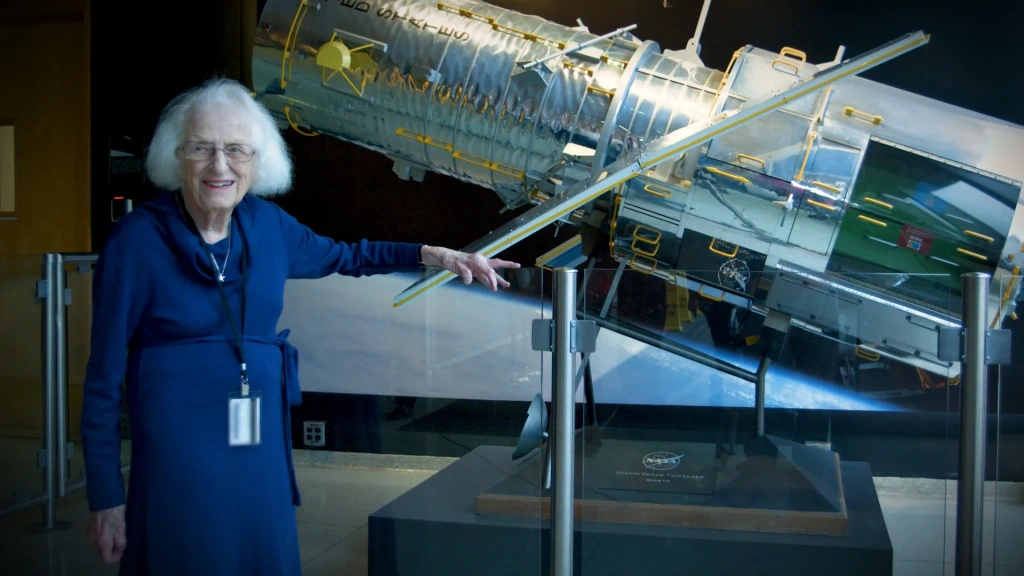
“I was told from the beginning that women could not be scientists.”
That was a common refrain from NASA’s first female executive, Nancy Roman. She joined the space agency in 1959 and served as its first Chief of Astronomy, developing the program from scratch. She was perhaps the first person to suggest the possibility of observing planets around other stars by launching a telescope into space. By the time she left NASA in 1979, she’d laid the groundwork for the launch of the Hubble Telescope a decade later and is often considered the “Mother of Hubble.” She died in 2018, but on Sunday morning at 7:26am ET, Hubble’s successor, the aptly named Nancy Grace Roman Telescope, will launch from the Kennedy Space Center in Florida.
Equipped with a 300-megapixel camera, Roman will head to the second Sun-Earth Lagrange point, approximately 1 million miles from Earth, where our planet will shield it from the sun’s light. It’s the same location where the James Webb telescope sits. But where Webb employs a high-powered zoom lens to capture celestial objects up to 13.5 billion light years away, Roman will provide a wide-angle look at our universe. Astronomers expect it to find more than a billion galaxies during its lifespan and see planets orbiting stars 26,000 light years from our sun.
Its field of view will be 100 times larger than that of Hubble, allowing it to survey 50 times the amount of space in five years than Hubble has in the last three decades, exploring hundreds of millions of stars, discovering an estimated 100,000 planets, observing tens of thousands of supernovae, and following the birth of black holes. The massive data sets will keep astronomers busy and work in tandem with NASA’s two other space telescopes to help unlock more of the mysteries of our universe.
Hubble helped reshape our understanding of the cosmos, revealing secrets like dark energy and supermassive black holes. No one yet knows what else awaits our discovery as the Roman and Webb telescopes bring the heavens into sharper focus.
It wasn’t easy to get Congress to approve Hubble, but Roman remained dogged, arguing that “for the price of one night at the movies each year, each American would receive 15 years of exciting discoveries.”
We’ve received much more than that, and with the launch of a telescope bearing her name, we’re about to get much more.
 Keep scrolling for more great stories.