

An Ingredient in Starbucks “Refreshers” Had Baristas Complaining of Choking and Hives
When Starbucks ends up having to create a webpage to ask "is ____ ingredient safe?", you know things aren't going great.
Photo via Starbucks DrinksSplinter Starbucks
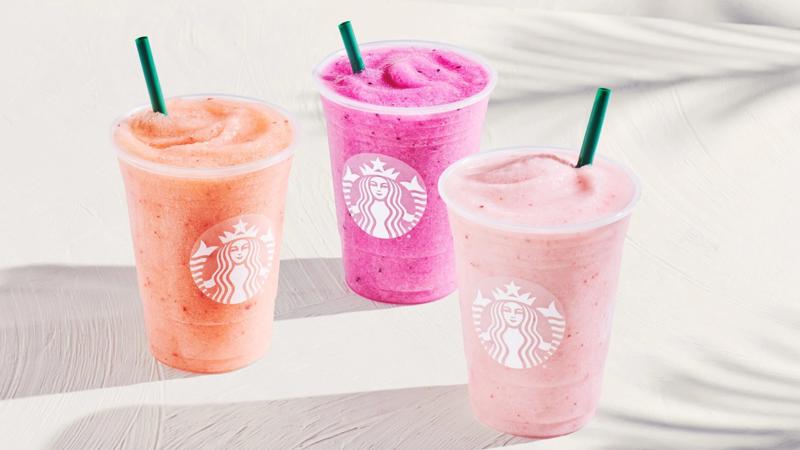
There are all too many jobs in America where laborers might find they need to worry about air quality. Coal miners, that’s obvious enough. There are also construction workers, fabricators or artisans who may deal with a lot of dust or particulate in the air. Or you know, practically anyone working outside at a time when we’re all routinely menaced by the hazards of wildfire smoke. But baristas, drizzling latte art in a coffee shop? You’d hope they would be spared from hives, asthma attacks and choking on the indoor air they’re breathing. As it turns out, getting a breath of fresh air might be harder when you’re working in a Starbucks, and it’s been liberally doused with a concoction staff have recently known as “blending powder.”
This week, Starbucks removed this particular ingredient–a necessary stabilizer in its line of frozen, “blended refreshers”–following seemingly innumerable complaints from staff in the many stores and cafes where the blending powder had been used in a seasonal promotion. Baristas reportedly complained that the extremely fine powder was difficult to keep from escaping into the air when it was poured into containers, drink cups or blenders, and that as a result “it kind of creates a smoke cloud,” which had people questioning “is this OK to breathe in?”
🚨Have you felt sick after handling Starbucks’ silica-based blending powder? If you’re a barista, reach out to us.
If you’re a Starbucks customer, we urge you to STOP BUYING STARBUCKS until the company finalizes union contracts with the protections and improvements we need.
— Starbucks Workers United (@sbworkersunited.org) 4:10 PM · Jul 24, 2026
Judging from some of the reactions, the employee concern may have been justified. Every time they went to create more fancifully named refreshers (like “blended mango dragonfruit lemonade”), they found themselves adversely affected.
“Any time I had to use it, I had to hold my breath,” said barista Destiny Valencia, who also described the “smoke cloud” above to The New York Times. She went on to describe coworkers complaining of coughs and persistent sore throats, while other baristas reportedly cited skin reactions like hives or respiratory problems like asthma attacks. It doesn’t take much searching to find multiple reddit threads from Starbucks employees in the last few months dedicated to the subject, with one person describing their experience in these terms:
Hey, I have been a partner for a little over a year, I work in Southern California. I have worked 2 shifts since we have introduced the blending powder, and BOTH shifts within 12 hours of leaving I have noticed my throat feeling tighter and sort of swollen. Swallowing becomes more difficult, and I feel like i can’t get a full breath in through my mouth without feeling a need to cough. I do not experience this sensation regularly and tbh I didn’t even put the correlation together until I heard others talking about it. I just thought I would share this in case any other partners have noticed anything similar. I don’t know what to do.
Thankfully, at least some Starbucks employees (at 700 of nearly 17,000 U.S. stores) have a union, Workers United, after weathering intense opposition from ownership. Said union hailed the corporate decision to remove the “blending powder” from stores following worker complaints and public social media posting. But they want more, like Starbucks agreeing to consult with baristas before it introduces new ingredients that could have potential widespread health impacts. The union asked Dr. Peter Orris, an occupational health physician from the University of Illinois, to provide an opinion, and Orris concluded that even if the ingredients in Starbucks blending powder were technically deemed safe, the company “should have evaluated it with respect to its impact on human health prior to introducing it in a setting exposing both employees and customers to the aerosolized powder through both inhalation and skin deposition.”
Starbucks, naturally, just notes that the problem is definitely solved and isn’t the kind of thing anyone should bother asking about. As a company spokesperson put it: “Partners and customers can feel confident in the ingredients we use.” Alright then.
ICYMI: Starbucks is discontinuing the blending powder right after our union escalated on the issue. Interesting how that works!
— Starbucks Workers United (@sbworkersunited.org) 4:42 PM · Aug 27, 2026
What exactly is this blending powder, though? Well, it’s a key ingredient in making one of these refreshers–and if you’re not familiar with the economic concept of a “refresher” in the first place, it’s a category that Starbucks originally pioneered in the early 2010s. Essentially, these are fruit flavor-forward, but lighter-bodied cold drinks that are designed to be sweet and visually eye-grabbing, arguably designed more for Instagram and TikTok aesthetics than any actual questions of flavor. Most have some level of caffeine in them, but beyond that they’re an endlessly evolving hodgepodge of fruit flavor combinations and eye-popping colors, each attempting to get Gen Z customers to pose with them on social media. It’s a product category that has been immensely successful and has since been copied by the likes of McDonalds, Sonic and Dunkin’, beyond making up a big chunk of Starbucks’ bottom line. In fact, refreshers and other cold drinks are now a far bigger deal for Starbucks than hot drinks (like traditional coffee) are: Two-thirds of all drinks sold at Starbucks are now cold. Turns out people are more into this than olive oil in their coffee; who knew?
The “blending powder,” meanwhile, is a combination of various stabilizers and texture enhancers that keeps one of these frozen fruit drinks from separating into stratified layers of ice and flavoring. One of those ingredients caught a lot of attention, however: What Starbucks describes as “food-grade silica.” This raised alarm among some observers because crystalline silica is known to cause lethal lung disease via breathing exposure, and is a serious problem in industries such as stone countertop manufacturing. The silica in Starbucks’ powder, meanwhile, is amorphous silica, used to prevent clumping in the powder, and is approved by the Food and Drug Administration. But that didn’t stop those employee complaints, which even involved a complaint filed with the Occupational Safety and Health Administration (OSHA) in Maryland at one point. Starbucks said that complaint was “resolved.”
🚨Here’s what baristas are saying about Starbucks’s blending powder.
Workers are calling on all customers to STOP BUYING STARBUCKS until baristas get protections and better in-store conditions finalized in fair union contracts.
— Starbucks Workers United (@sbworkersunited.org) 4:16 PM · Jul 22, 2026
You can tell that this particular bugaboo must have reached a critical mass within the company, meanwhile, by the fact that they have a page on the website ready to point people at about precisely this, with the not-at-all-concerning headline, “Is the blending powder used for Blended Refreshers safe?” Would you believe that it then concludes that yes, it is safe? The company went on to offer more guidance and training to baristas about how to pour and transfer the powder to reduce how much of it was getting into the air, but at that point you kind of have to wonder whether it’s worth disgruntled employees coughing and spiting your company, when you can just, you know, pivot to other cold refreshers. Starbucks seemingly concluded the same thing soon after.
Still, there’s something wonderfully dystopian in a line from a Starbucks spokesperson like the following given to NYT: “It’s safe for use in food and safe for use in our coffeehouses when used according to instructions.”
I’m just going to go out on a limb and say that if you need to add the phrase “…when used according to instructions” to something drink-related that began with “It’s safe for use,” then the thing you’re talking about is probably more trouble than it’s worth. After all, no one wants a barista having an asthma attack in the background of their Instagram reel.
 Keep scrolling for more great stories.