

New Project 2025 L Just Dropped: The Admin’s Sending Wild Horses Off to Die
America’s federally protected wild horses are not supposed to be slaughtered—but the government’s found a cruel and expensive loophole.
Photo: Unsplash Trump Administration Horses
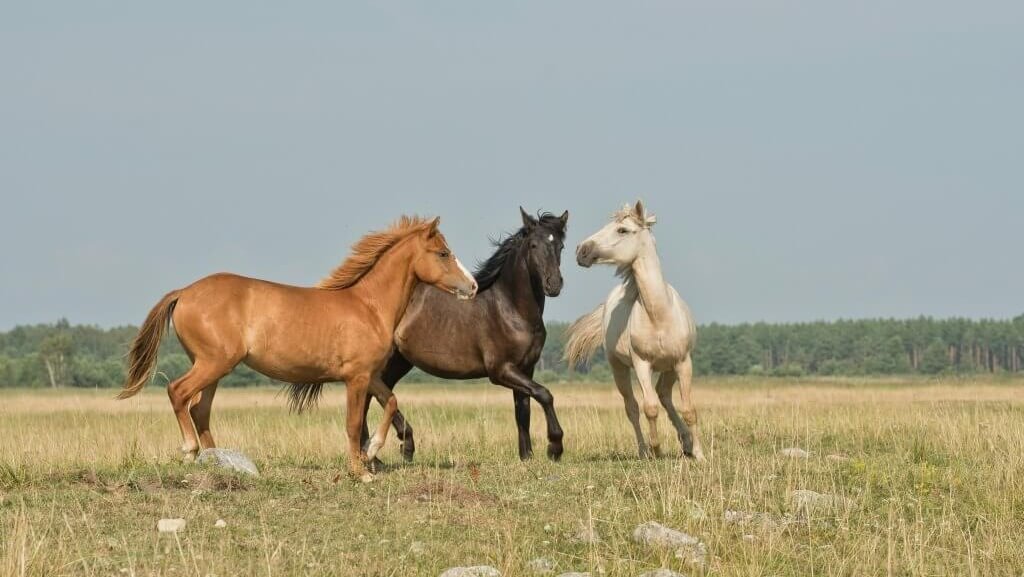
America’s federally protected wild horses are not supposed to be slaughtered. Congress specifically protected herds of unclaimed, free-roaming horses living on certain federal lands as “living symbols” of the American West in 1971. But the Trump administration has found a disturbing loophole, according to new reporting from The New York Times: Round them up, sell them into private ownership for as little as $25, and then absolve itself from keeping track of what happens to them.
So how does a protected wild horse potentially end up in the slaughter pipeline? It starts with a helicopter.
First, the horses have to be captured. The Bureau of Land Management uses low-flying helicopters to chase wild herds across the Western landscape and funnel them into corrals, sometimes running animals for miles. From there, they’re loaded onto trucks and transported to government-holding facilities.
The Trump administration’s perverse excuse for capturing wild horses is that their populations reproduce quickly and can overwhelm food and water. But the system it has created to deal with that problem is both brutal and insanely expensive.
Currently, there are tens of thousands of wild horses and burros sitting in government-holding facilities. Some live in pastures, while others are kept in feedlot-style corrals. Maintaining them costs taxpayers around $100 million a year, with short-term corrals costing roughly $6 per animal per day.
So the government has essentially built itself a wild-horse conveyor belt: Capture them, warehouse them, spend enormous amounts feeding them—and then figure out how to secretly get rid of them.
The administration has explicitly called for “large-scale placement and sales initiatives,” and the number of horses and burros sold by BLM more than doubled from 2024 to 2025. Some animals have previously been offered for as little as $25 to some random farmer in Ohio, whose background the government probably didn’t even check. That’s also a disgustingly low price for an animal that costs the government thousands of dollars to capture and maintain.
This is where things get even shadier.
Animal-welfare groups have documented cases where federally managed horses appear at livestock auctions and “kill pens,” which is where horses can enter the commercial slaughter pipeline. But the thing is, since America currently has no operating commercial horse slaughterhouses, these horses are instead being sent abroad to be killed for meat.
Still, BLM insists it does not sell horses to slaughter and will ban buyers caught funneling animals into such a pipeline. But once a horse is sold, the agency generally stops tracking it. So there are horses that leave federal custody whose ultimate whereabouts the government simply cannot tell you.
And—because every disturbing policy rabbit hole now apparently ends here—this was laid out in Project 2025.
The conservative blueprint specifically complains about the wild-horse population and recommends that Congress allow BLM to “dispose humanely” of excess animals. Because “dispose humanely” is… totally not an oxymoron.
Still, overpopulation remains an issue—the New York Times found federal documents that have discussed using trained marksmen and projectile-based methods during round-up operations. BLM euthanasia policies permit methods including gunshots under certain circumstances. Bureau leaders have also floated using sharp shooters or building gas chambers to reduce populations.
As shocking and gruesome as this story is, it’s a perfect microcosm of Trump-era government: Take a complicated problem, declare the humane solution too expensive, strip away the regulations making it expensive, and call the resulting cruelty efficiency.
Wild horses were once considered so quintessentially American that Congress unanimously voted to protect them in 1971. Fifty-five years later, the federal government is debating whether keeping that promise costs too much.
 Keep scrolling for more great stories.