

A Bunch of Race Cars, Going 180 MPH on D.C. City Streets Next to Historical Landmarks. What Could Go Wrong?
Is it a good sign that the National Gallery of Art has already "braced some of its most fragile works" for this IndyCar event?
Photo via Unsplash, Jonathan Ikemura SplinterSports racing
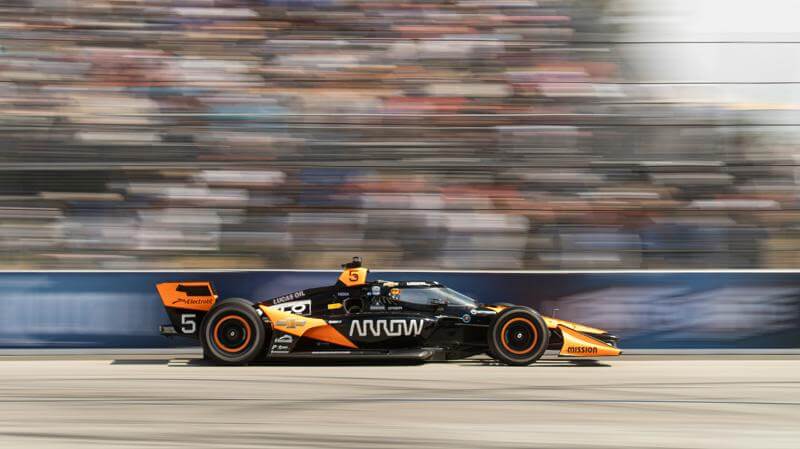
Credit where credit is due: As far as publicity stunts for the 250th anniversary of the United States go, having a fleet of IndyCars flying down the commercial, public roadways of Washington D.C. and careening around curves right next to critical government infrastructure buildings does have a certain, Idiocracy-adjacent panache to it. At the very least, I think it’s reasonable to assume that way, way, way more people are going to be interested in watching this premise than were hyped up to attend, say, the embarrassingly empty “Great American State Fair” on the National Mall, with its Temu arch and wide open spaces devoid of attractions or enthusiasm. I wouldn’t be surprised if it does some good TV ratings! If only because half the viewers are watching in anticipation of some kind of “Trump touched this event and therefore it’s going to explode” disaster, which so often travels in his wake.
It doesn’t seem like a great sign, for instance, that art historians and scholars are raising all sorts of alarm bells about the fact that the open city course for the so-called Freedom 250 Grand Prix (an official IndyCar event) passes right next to buildings such as the National Gallery of Art and the National Archives Building, which obviously contain a lot of very old, very sensitive documents and artwork. The obvious concern, beyond the visual of some race car launching into the air and embedding in the side of a museum, is that high levels of vibration and noise could result in damage to the exceedingly delicate works in those museums. The New York Times has already reported that the National Gallery of Art’s east building has “braced some of its most fragile works” in anticipation, while the outdoor sculpture garden has apparently been boarded up for protection.
Preservationists from across the country are worried about the side effects of the Freedom 250 Grand Prix, particularly the vibrations from race cars thundering past landmarks including the National Gallery of Art.
— NOTUS Metro (@notusmetro.bsky.social) 11:00 AM · Aug 21, 2026
The official government spokespeople for those institutions–you know, people that Trump could instantly fire at will–unsurprisingly say that all is fine. Chris Abanavas, spokesman for the National Gallery of Art, told NPR that the museum had “conducted an extensive vibration study and based on the results we have implemented a set of measures to ensure the safety of our staff, visitors, collection, and facilities during the race.”
People not currently on the federal payroll, on the other hand, are considerably more concerned about what kind of damage a Wacky Races event through the streets of D.C. could do to art being stored a stone’s throw away. There are mitigation steps to take, such as transferring certain at-risk works to parts of the building less potentially affected by vibration, but with this administration you always have to wonder whether anyone will even care enough to take those steps, or if that would be seen as betraying Donald Trump’s glorious race day. Because yeah, why should we acknowledge how different it will physically be to have IndyCars traveling 180 mph down these roads, which usually have 25 mph speed limits?
“For several hours of racing cars, we might be risking … the access to these extraordinary works for future generations,” said art historian Mary Okin to NPR. “The fact that there is an insistence that it has to go by and around major collections of art — whether or not those collections get damaged — is absolutely ridiculous and foolish and indicates a lack of care about the things that belong to the American people.”
Then you have the indisputable fact that this particular race was thrown together and added to the IndyCar schedule on the Trump administration’s typically rushed, hectic timetable, with far less time for preparation than is typical for these events despite the fact that it’s happening in an entirely new location, on public streets. Bud Denker, the president of the Penske Corporation and chair of the Freedom 250 Grand Prix, admitted in a recent interview exactly how rushed this whole thing has been: “Instead of having two-and-a-half years to plan this thing, I’ve had seven months. So it’s been a tough one.” Is this the sort of thing you want to hear your event organizer say, days before holding an event involving grandstands full of spectators and cars going seven times the typical speed limit on those streets?
Fun fact: Trump and co. originally apparently wanted the race to be built in a course around the Capitol building, but that would have required congressional approval because of federal law prohibiting commercial advertising on the Capitol grounds. Denker claims to have held more than 100 meetings with members of Congress over a six-month period attempting to sway them to this plan, only to be rebuffed. So obviously, “racing right next to the Smithsonian and Hirshhorn Museum” was the obvious backup plan to then engage in, which was authorized by Trump in a late January executive order. That has left a handful of months to work out everything from heightened event security, to building temporary grandstands, closing roads, and “temporarily welding shut hundreds of manhole covers on the route” so one doesn’t slice off a spectator’s head like an Indiana Jones temple trap. I for one can’t wait to see if they missed a manhole cover or two!
The speed limit on Pennsylvania Avenue NW is 25 mph. But this weekend, racecars will zoom at speeds as high as 185 mph during the Freedom 250 Grand Prix.
All 220 manholes were welded down to prevent them from going flying when cars zip over them.
— The Washington Post (@washingtonpost.com) 2:00 AM · Aug 19, 2026
IndyCar’s own officials have attempted to smooth things over and ease any worries, insisting that the organization has put on plenty of high-profile races in other historic urban areas, such as one in close proximity to the Dali Museum in St. Petersburg, Florida. Alex Damron, a company spokesperson, said the following: “With this excellent track record and the thorough preparation we have done for this event, working closely with all the appropriate local and federal agencies, we do not anticipate any impact on the structures surrounding the circuit as a result of the race.”
I think I speak for all of us, however, when I say that trusting an organization like IndyCar to figure out its own logistics for a race is one thing, and trusting the Trump administration to do so on its typically rushed, give-no-fucks timeline is something else entirely. We are talking about an administration and President that have constantly demonstrated their pathological inability to admit to making mistakes, even on relatively inconsequential matters like the botched waterproof coating applied to the bottom of the Lincoln Memorial reflecting pool. When that poorly executed, rushed job went bad, the instinct of the administration was to arrest and charge random American citizens who happened to be passing by, proclaiming them “vandals” even after it had received reporting that the damage was from shoddy work, rather than vandalism. With those instincts, how would the administration react to damaged art or documents in its museums following the IndyCar race? Hell, they’d probably charge the curators as vandals too. Can you even conceive of a timeline where any member of the administration would take the blame or concede that the race was a bad idea, even if damage occurred?
As for the actual logistics of Sunday’s race, it will consist of roughly 250 miles, broken down into 147 laps on a 1.7-mile course that twists and turns through the museum district of D.C., with many of IndyCar’s top stars such as series champion Alex Palou and Indy 500 winner Felix Rosenqvist participating. The track has a little bit of everything, including multiple sharp turns in a row, and even a rare right turn, which is always an IndyCar oddity. Cars will supposedly reach their top speed of up to 190 mph while flying down Pennsylvania Avenue itself, which Trump hilariously admitted “wasn’t exactly designed for that.” Oh, by all means don’t let that stop you, big guy.
If you do happen to be attending the race, hopefully out of the maximum distance of airborne manhole covers, then be sure to send us the view from your seat. But please, take note: There is no outside food allowed. The government has to start addressing its $40 trillion national debt somewhere, after all, so please purchase a patriotic hot dog to do your part.
Oh my god. Indycar what are you doing
 Keep scrolling for more great stories.